







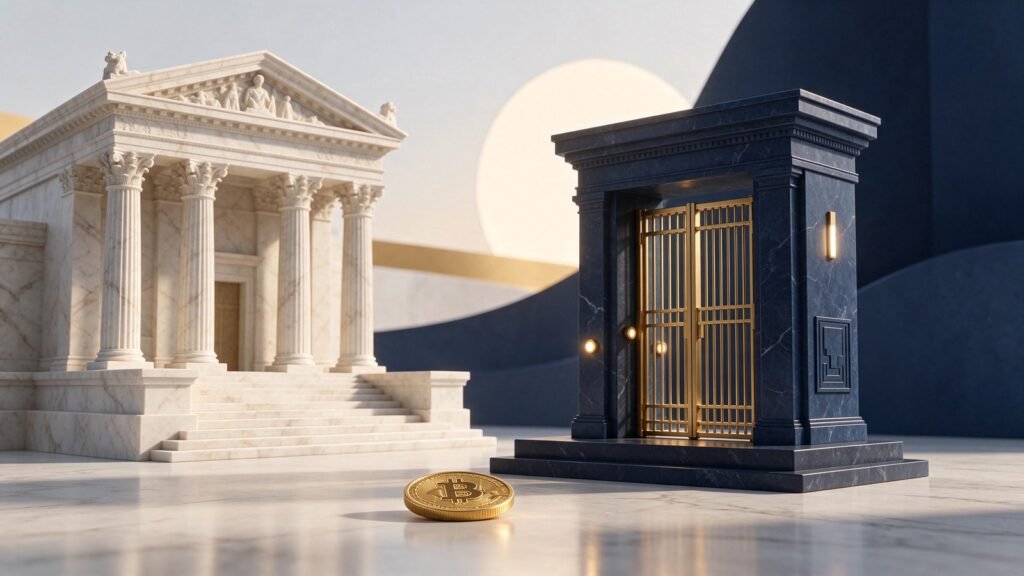
The Custodia Fed master account case has reached the end of its current Supreme Court challenge. On November 16, the justices declined to review the crypto-focused bank’s appeal, leaving a lower-court judgment on Federal Reserve payment access in place. The important distinction: the Supreme Court did not issue a new ruling on the merits or announce a blanket ban on crypto banking.
What did the Supreme Court decide?
The Court’s November 16 order list places case No. 26-62, Custodia Bank, Inc. v. Federal Reserve Board, under “Certiorari Denied.” In plain English, the Court chose not to hear the appeal. The short entry does not explain why.
That leaves the Tenth Circuit’s October 31, 2025 judgment standing. In its published opinion, the appeals court concluded that Federal Reserve Banks have discretion to reject master-account requests from otherwise eligible institutions. Eligibility to apply, in other words, does not guarantee approval.
What is a Fed master account?
A master account is the account through which an institution can hold balances at a Federal Reserve Bank and access central-bank payment services directly. Without its own account, a bank generally needs an intermediary relationship for those services. For Custodia, direct access has been a central part of its long-running dispute with the Fed.
This is about the connection to payment infrastructure—not permission to buy Bitcoin, a crypto-exchange listing or approval for every activity a bank might offer. The latest order does not take away an account Custodia already held.
Why the case matters for crypto banking
The practical takeaway is that a qualifying charter alone does not settle the payment-access question. A business assessing a crypto bank still needs to ask who provides its dollar-payment connection, what services are actually available and which approvals cover them.
Those distinctions are easy to blur. Deutsche Bank’s crypto custody rollout, for example, concerns holding and transferring selected digital assets for eligible clients. Custody is a different service from obtaining a U.S. central-bank account.
Likewise, PNC’s USDC-to-dollar payments pilot illustrates a separate banking workflow: incoming stablecoins are converted into dollars for participating clients. Neither development changes the specific legal outcome of Custodia’s appeal.
What the court denial does not establish
A refusal to hear a case is not a Supreme Court endorsement of every argument below. It also does not, by itself, create a nationwide prohibition on crypto banks, rewrite Fed account-access rules or decide the fate of every future application. Any new application or proposed limited-access arrangement would need its own assessment.
There is another distinction worth keeping straight: Fed membership and a Reserve Bank master account are separate matters. The Fed’s January 2023 announcement denied Custodia’s membership application. That historical decision should not be presented as a fresh November 2026 order or confused with the Supreme Court’s review decision.
Quick questions
Did the Supreme Court hear Custodia’s appeal?
No. It declined review on November 16, 2026. The lower-court judgment remains in place without a new Supreme Court merits opinion.
Does this ban Bitcoin or all crypto banks?
No. The order concerns Custodia’s petition in a dispute over direct Federal Reserve payment access, not a general prohibition on owning crypto or operating a crypto-related business.
This article is for information, not financial or legal advice.