
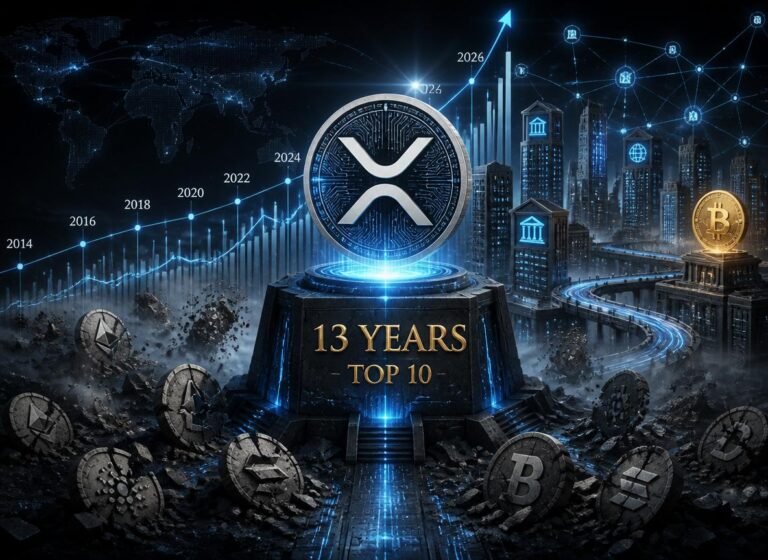
The Only Altcoin That Has Never Left Crypto’s Top 10 in 13 Years — And It’s Not Ethereum
Crypto is the most ruthless market on the planet.
Projects worth billions disappear overnight. Coins that dominate headlines one year vanish from the top 100 the next. Entire narratives — ICOs, DeFi summers, NFT booms — rise and fall within months, taking thousands of tokens down with them.
And yet, through every single one of those cycles, one coin has done something nobody else has managed to pull off.
XRP has stayed in crypto’s top 10 every single year since 2014. Thirteen years straight. Through bull markets, bear markets, a landmark SEC lawsuit, multiple crypto winters, and a parade of rivals that each promised to dethrone it.
Not one of them did.
What CoinGecko’s Data Actually Shows
A fresh research report from CoinGecko has just confirmed what XRP holders have quietly known for years — and put hard numbers behind it for the first time.
XRP is the only cryptocurrency besides Bitcoin to remain among the world’s top 10 digital assets by market capitalization every year since 2014 — a feat no other altcoin has achieved.
The data is based on market cap rankings from June 1 of each year, so the study compares annual snapshots rather than full-year averages or daily rankings across the period. 2013 was excluded from the study, as CoinGecko argues its historical market cap data for that year was “too sparse and incomplete” for a reliable top 10 ranking.
The numbers tell an extraordinary story of consistent survival. In 2014, XRP came in at the number eight position with a market cap of just $32 million and a 0.3% share of the top 10 market cap rankings. By 2026, XRP had become the number five with an $82.5 billion market cap and a share of 3.6%.
From $32 million to $82.5 billion. From 0.3% of the top 10 to 3.6%. Across thirteen years of the most volatile market in financial history.
That’s not luck. That’s something much more interesting.
The Graveyard of Coins That Couldn’t Keep Up
Here’s the part of the CoinGecko report that really puts XRP’s achievement into perspective — the list of once-dominant coins that couldn’t survive.
Most of the big currencies from the early days of the crypto industry lost their position in the top 10. Litecoin was the third-biggest token in 2014 and maintained its place in the top 10 until 2020. Besides Litecoin, altcoins such as Solarcoin, Peercoin, Namecoin, Blackcoin, and NXT were in the 2014 top 10 too — but have all lost their place.
Remember those names? Most crypto investors born after 2018 probably don’t — and that’s exactly the point.
Litecoin, once called “silver to Bitcoin’s gold,” eventually fell out of the top 10 after holding on for six years. The others — Solarcoin, Peercoin, Namecoin, Blackcoin, NXT — once commanded billions in market cap between them. Today, most trade in the margins of obscurity, shadows of what they once were.
While many once-dominant crypto assets have faded into the background, XRP has continued to hold its ground through bull markets, bear markets, regulatory battles, and shifting investor sentiment — cementing its status as one of the most enduring assets in cryptocurrency history.
Every single one of XRP’s contemporaries from 2014 has either disappeared from the top 10 or collapsed entirely. XRP is the last one standing.
The Rise, the Peak, and the Fight to Stay Relevant
XRP’s journey through thirteen years of crypto has not been a smooth upward line. It has been one of the most turbulent rides in the entire market — full of spectacular highs, brutal crashes, and one of the most consequential regulatory battles the crypto industry has ever seen.
The all-time high position of XRP in the ranking was achieved in 2015, when XRP was in the second position, after Bitcoin. XRP was also in third place in 2017, 2018, and 2019 — until stablecoins, exchange native tokens, and Layer-1 tokens took over.
Second place overall in 2015. Third place three years running from 2017 to 2019. At its peak, XRP was the undisputed number two in all of crypto — bigger than Ethereum by market cap for extended periods, commanding the attention of every institutional investor on the planet.
Then came the competition — and it was fierce. Ethereum’s DeFi explosion. Binance Coin’s rise as exchange native tokens became their own category. The stablecoin wave that saw USDT and USDC eat into market share. Solana’s emergence as a high-speed challenger. Each new wave brought powerful new competitors with billions in backing.
XRP didn’t top those cycles. But it survived all of them. And in crypto, survival is the rarest achievement of all.
The lowest point came in December 2020, when the SEC filed a landmark lawsuit against Ripple, alleging XRP was an unregistered security. The price crashed. Exchanges delisted it. Most analysts wrote XRP off as finished. It seemed like the end.
Instead, Ripple fought back — and won. The landmark legal victory that followed didn’t just save XRP. It fundamentally reshaped how regulators and courts approach crypto assets in the United States, setting precedents that the entire industry is still benefiting from today.
Why Has XRP Survived When Everything Else Faded?
This is the question every crypto investor should be asking — because the answer reveals something important about what makes a crypto asset genuinely durable.
Three things separate XRP from every other altcoin that has come and gone.
First — Real utility from day one. XRP was never just a speculative token with a whitepaper and a promise. From 2013, it was designed as a bridge currency for cross-border payments — solving a real problem that the global banking system had failed to fix for decades. Ripple’s payment network gave XRP an actual use case before most of its competitors even existed.
Second — Institutional backing that outlasted the cycles. While retail investors chased meme coins and new narratives, XRP maintained serious institutional relationships. Banks, payment companies, and financial institutions across Asia, the Middle East, and Europe continued building on the XRP Ledger even during the darkest regulatory period.
Third — The network effect of trust. In a crypto market defined by constant rotation and collapse, XRP stands out for one rare quality — persistence. Through every major market cycle, XRP has maintained its position among the industry’s elite. That consistency itself became a signal — and signals attract capital.
What the Numbers Look Like Right Now
Here’s where XRP stands in 2026 — and why the story isn’t just historical.
By 2025, XRP had climbed to fourth place with a market capitalization of roughly $127.9 billion and a 4.3% share of the top-10 market. Since then, the market has shifted, with XRP currently holding a market cap of around $82.5 billion — still firmly in the top five despite the broader market pullback.
Today, as attention turns toward the tokenization of real-world assets — a sector some analysts believe could scale into the hundreds of trillions — XRP is again being reassessed through a long-term lens. With the XRP Ledger increasingly positioned for settlement and asset transfer use cases, its uninterrupted presence in the top 10 is no longer just a historical footnote. It’s becoming part of its investment narrative.
Goldman Sachs has become the largest institutional holder of XRP ETFs. Aviva Investors — one of Europe’s biggest asset managers — is tokenizing funds directly on the XRP Ledger. Ripple joined BlackRock and JPMorgan in the DTCC’s tokenization rollout scheduled for July 2026. The institutional infrastructure being built around XRP in 2026 is the most impressive in the asset’s entire history.
The Rivals Who Tried — And Couldn’t Dethrone It
Let’s be honest about the competition, because XRP has faced genuine threats to its top 10 status multiple times.
Ethereum came closest — not by pushing XRP out of the top 10, but by repeatedly threatening to push it down toward the bottom of it. During the 2021 DeFi boom, Ethereum’s ecosystem was generating so much activity that XRP’s payment-focused narrative seemed almost quaint.
Solana, Cardano, Avalanche, Polkadot — each had their moment in the sun where analysts predicted they would permanently displace XRP. Each time, the prediction proved premature. XRP absorbed the competition, held its ground, and waited for the next cycle.
The most recent threat came from the meme coin wave of 2024-2025, when Dogecoin and Shiba Inu briefly entered top-10 territory on the strength of retail enthusiasm alone. Neither has maintained that position with consistency. XRP — boring, utility-focused, institutional XRP — outlasted the dog coins too.
What This Means for XRP Investors Today
Thirteen consecutive years in crypto’s top 10 isn’t just a fun fact for trivia night. It’s a serious investment signal — and here’s why.
Every year that XRP remains in the top 10 makes it statistically harder to dislodge. Network effects compound. Institutional relationships deepen. Developer activity on the XRP Ledger accumulates. The longer XRP stays relevant, the more infrastructure gets built around it, and the more infrastructure that gets built, the harder it becomes to displace.
Think of it like a city. The longer a city exists, the more roads, utilities, businesses, and social networks build up around it. Those layers of infrastructure make it increasingly difficult for a new city to simply replace it — no matter how well-planned the new city is.
XRP at thirteen years in the top 10 is a city with deeply embedded infrastructure. The roads go everywhere. The utilities are reliable. The institutions have already moved in.
And with real-world asset tokenization, AI agent payments, and stablecoin settlement all converging on blockchain infrastructure — XRP’s core use case as a fast, cheap, reliable settlement layer is more relevant in 2026 than it has ever been in its entire history.
Summary
Thirteen years. Every single one of them in crypto’s top 10. Through a landmark SEC lawsuit. Through four full bear markets. Through the rise of DeFi, NFTs, meme coins, AI tokens, and a dozen other narratives that were supposed to make XRP irrelevant.
Since 2014, XRP has been the only cryptocurrency, other than Bitcoin, to consistently stay in the top 10 by market capitalization — a 12-year run that underscores its durability in an industry where few assets survive multiple cycles.
Litecoin couldn’t do it. Ethereum wasn’t around early enough to match the streak. Solana, BNB, Cardano — none of them have been in the top 10 for thirteen consecutive years.
Only Bitcoin has done what XRP has done. And Bitcoin had a ten-year head start.
Whatever you think about XRP’s price potential, its tokenomics, or Ripple’s business model — you cannot argue with thirteen years of unbroken relevance in the most ruthless market ever created.
In crypto, surviving is the ultimate achievement. XRP just proved it for the thirteenth year in a row.
Get daily XRP analysis and crypto market news at thecryptoner.xyz